Maintaining clean amenities is just as important as keeping your site nice and tidy. Employers have a duty to provide adequate workplace amenities/facilities, including toilets, that are in good working order, clean, safe and accessible.
When planning amenities on your site, consult with your workers to understand what will be needed. Getting them involved will give you the opportunity to provide information, training and instruction on things like keeping the site amenities clean and reporting any problems.
Portable Toilets
More often than not portable toilets are not maintained in a safe or hygienic way. Employers must make sure that toilets are cleaned and serviced regularly, making sure they are safe to use, just like any other on-site machinery.
Toilets should also:
- Be completely enclosed, to ensure privacy
- Be provided with a door that can be locked from the inside
- Have enough water for flushing and washing hands
- Stocked with toilet paper, rubbish bins and hygienic means to dispose of sanitary items
- Supplied with soap or a suitable alternative such as alcohol based sanitiser
Don’t forget, the toilet should be easy to access in all weather conditions and be placed on stable, flat ground to ensure it can operate properly.
Drinking water
Clean drinking water must be supplied to workers by installing site water taps as early as possible. If the mains have not been connected, provide workers with drinking water in containers, coolers or flasks.
Meal and shelter facilities
Workers should have a clean and sheltered area for meals and rest breaks. A garage or a similar sheltered area can be used or a vehicle cab if there is no other reasonably practicable option, so long as basic requirements for worker rest can be met.
Not meeting these requirements can lead to a risk of infection, disease, psychosocial harm or infringements/enforcement from the Regulator. Planning is key to ensuring you and your team have what you need in place from start to finish.
As always, if you have any questions please give our team a call on 0800 555 339 or contact us.
Making sure your scaffolding is safe and ready for action is key. Here are the times you’ve got to give it a good once over:
- After Installation: Right after it’s set up.
- Every 7 Days: Yep, regular check-ups like clockwork.
- After Tweaks: Any time you make changes, give it a good once-over.
- Post-Storm or Shake-Up: If mother nature throws a fit, give it a look.
- Daily Check Before Use: A quick safety scan before diving in each day.
All scaffolds must be checked by a competent person before handover and scaffolds taller than 5m must be erected and inspected by someone who holds the appropriate Certificate of Competence (COC). Handover checks involve tagging the scaffolding. No matter the height, all scaffolding must have a tag clearly displaying important safety information at access points. The tag should include the following:
- Safety Status: Whether it is safe or unsafe to use.
- Contact details: The name and contact phone number of the person who erected it
- Purpose: What the scaffold is being used for
- Weight Limits: The weight loadings of the scaffold
- Platform limits: The maximum number of platforms or bays that may be loaded
- Limits of Use: Any limitations on the use of the scaffold
- Records: A record of each inspection including who inspected or altered the scaffold and when it was done.
If there’s no tag, do not use it! Get in touch with your scaffold installer to sort it out and get it tagged.
Before starting each day, a pre-start check should be done. This can be done by a competent scaffold user using the HazardCo scaffolding pre-start checklist available from the Hazardco HUB.
Every week a certified scaffolder (if over 5m) or competent person (under 5m) should be checking the scaffolding to make sure it is safe. If the inspector has found any damages or non-compliant areas of the scaffold, then the access ladders need to be removed and the tag updated stating the scaffold is not compliant and should not be used.
A thorough inspection of your scaffolding should also be conducted after any tweaks, fixes, or wild weather. And don’t forget to keep records of all these inspections.
If you have any questions get in touch with the team at HazardCo or have a look at our other working at heights blog here
Proper management of hazardous substances on-site is important to keep everyone and our environment safe. Legally speaking, hazardous substances refer to substances which have any of the following properties:
- Explosive
- Flammable
- Able to oxidise – (create oxygen)
- Corrosive
- Toxic to humans or the environment
If you are using any hazardous substance in the workplace you need to make sure they are stored, used, transported and disposed of correctly, which will help to reduce the risk to anyone who uses or comes into contact with them.
To capture what hazardous substances you are using you must by law have a hazardous substance register along with the relevant safety data sheet (SDS).
What is a Hazardous substance register?
This is a list of all your hazardous substances (including hazardous waste) that is used, handled, or stored at any of your sites. Having a register will ensure you know the substances you have on-site, the safety measures you need to follow, and what to do in case of an emergency.
Keeping a Hazardous substance register
Keeping your register in a central location on your site means that in case of an emergency, it can be accessed quickly by anyone who needs it.
Here are some key bits of information that need to be included on your register:
- The name of the substance and, if available, its UN number
- A current safety data sheet or a condensed version of the key information from the safety data sheet
- The maximum amount that is stored at the workplace
- Where it’s located
- Specific storage requirements
- Any hazardous waste
Not only do you need the information above, but you must also make sure that the register is up to date and available on-site.
As the register represents the maximum amount of the substance held, it means it’s not going to be a daily task to keep it up-to-date. But if the maximum quantity changes, the register needs to reflect this. We recommend that you review your register each time you make a change to ensure it’s up to date and accurate.
How do I create a hazardous substance register?
Creating your hazardous substance register is made much simpler with our Hazardous Substances Register, HazardCo members can access this via the HazardCo Hub in the templates section.
Safety Data Sheet (SDS)
The purpose of a safety data sheet (SDS) is to provide key information about hazardous substances to the people who handle, use or store them or who could be exposed to them.
An SDS tells you
- The product (its name, ingredients and properties)
- Who manufactured or imported it
- How the product can affect your health
- How to use, store and transport it safely
- How to manage an emergency involving the substance
Remember it is the business owner’s responsibility to have an up to date SDS for each hazardous substance and make sure that their workers have access to it. The SDS must be less than 5 years old.
If you need a hand getting started with your hazardous substances register or would like more information, get in touch with the friendly HazardCo team today – we’re always happy to help.
Over the last 18 months, consents for multi-unit dwellings have grown to the point where there are more multi-unit consents each month than for standalone houses. Coupled with the current economic climate and the security that comes from Council, Kainga Ora or Government work means we are seeing more and more of our residential builders starting to work beyond the more traditional single dwelling build.
How do you define Multi-Dwelling Housing?
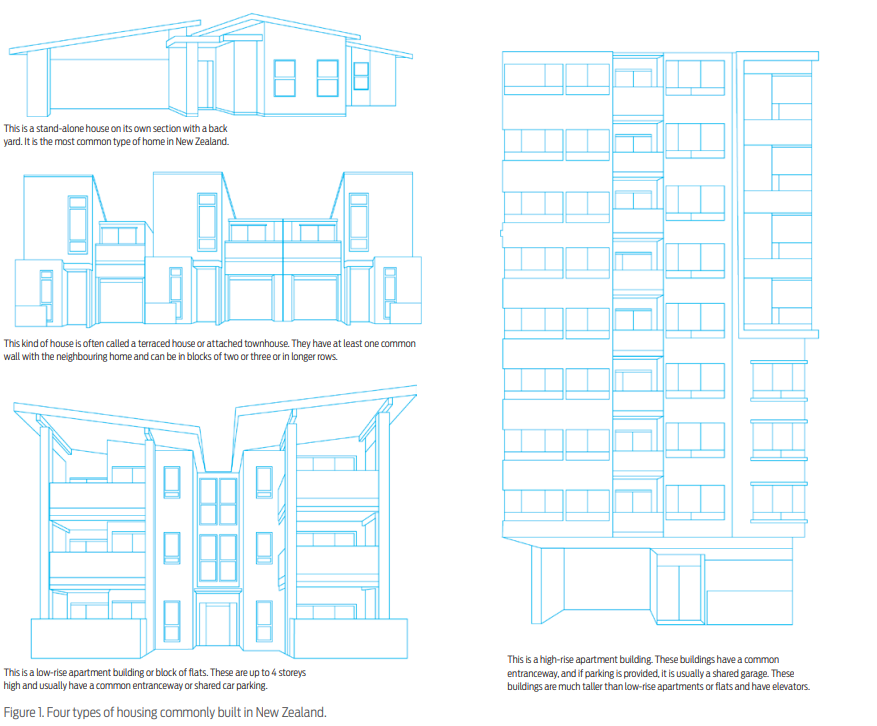
There are three different types of residential housing – low density, medium density, and high density.
- Low density – Usually 1-2 story residential building on an individual section
- Medium density – Multi-unit residential building on a single site eg townhouses, units, apartments and retirement villages
-
- 1–2 story attached houses (e.g. duplexes, triplexes, semi-attached terraced houses)
- 2–4 story attached houses (terraced houses)
- 3–6 story apartments
- High density – Apartment buildings, greater than 6 stories
With increasing pressure on New Zealand’s building stock, medium density housing is considered an attractive option to meet the changing housing needs. Demand for more compact homes is increasing, particularly in areas with rapid population growth (BRANZ, 2023). Multi- dwelling consents made up 48% of all consents in 2021 and were forecasted to continue to increase (Stats NZ, 2021).
What’s the difference?
The key difference between low and multi dwelling housing is the level of complexity required to manage the build and the likelihood of additional layers of responsibility e.g. directors and development owners as PCBU’s above the building contractor.
This complexity of communication around safety means that the builds are often not solely run by a Group Home Builder or single builder and their subbies. Instead, for example, they can be run by project management companies, involving large stages of the build process that is then run and managed by specialists. This adds additional complexities compared to low density housing.
There are often complex stages of these builds, which are generally run by specialised subbies e.g. planning (engineers, architects, quantity surveyors), and build stages (civil works, construction management, carpentry/joiners, concreting) etc.
Multi-dwelling Residential Requirements
Because multi-dwelling housing creates more risk on-site due to the increased amount of subbies, machinery, equipment, and high-risk work taking place, It’s important that you have the right H&S tools in place for your contractors and a safe system of work e.g Site Specific Safety Plan (SSSP) for all medium density builds.
A SSSP for a multi-dwelling build will outline how all involved parties will manage health and safety on-site. This includes a detailed agreement between parties on how they will manage subbies, their expectations, roles, and responsibilities to ensure that all relevant site safety information is available.
The SSSP is intended to be a detailed agreement and communication tool. Due to the potential complexity of multi-dwelling builds, we always recommend a more detailed and customised SSSP.
The extra complexities that can need extra planning and control include:
- Pre-planning of the project, because there are many moving parts, schedules and sensitive timelines.
- Detailing key parties, subbies, and their contact details.
- Multiple responsibilities, e.g. engineers, main contractors of key stages, multiple teams of trades.
- Outlining those shared responsibilities, and the expectations around how safety is to be managed e.g. who is in charge or what, how is information to be gathered and passed on and to whom. Who is in control of managing risks and when?
- The SSSP allows for the detailing of the hazards and risks that are likely to be faced, and what controls are to be used to reduce or eliminate those.
- Plans for emergencies and the site’s response throughout the build.
- Any specific requirements e.g. if working for a government entity, or any specific standards.
- More complex site boundaries e.g. large areas, houses that are sold whilst construction continues in other parts, site boundaries in close proximity to pedestrians etc.
- Traffic management needs, e.g. more trade parking, higher traffic flow of machinery or materials, cranes and concrete pump trucks, council requirements etc.
This list is not exhaustive but all of these complexities are often above and beyond a low density build and need planning, controlling, and communicating to ensure the health and safety of workers and others are managed well.
Got a new multi-dwelling build kicking off?
Project Pro and the HazardCo system are suitable and capable of meeting the H&S requirements of multi-dwelling builds, so you can feel confident that HazardCo can support you as your business grows.
If you are a builder starting to diversify, now’s the right time to review your Health and Safety activity.
That’s where HazardCo comes in. If you’re building 3 or more dwellings within a fenced-off section, you will need HazardCo’s Project Pro. This is a customised project, specifically for your build that gives you everything you need for your team and all the subcontractors you will have coming onto the site.
Here are some key components of Project Pro that will help you cover all your bases.
- 2 x Hazard Board with QR code
- Customised SSSP for the project (reviewed by a H&S Advisor)
- Large HazardCo mesh fence banner
- Full access to the HazardCo system to guide anyone scanning onto site
- In app guided activity to support learning
- Cloud storage of all safety documentation completed on site
- Reporting and analytics to identify opportunities and trends on site
- Support from our Customer support and Advisory teams
If you have a new multi-dwelling residential project kicking off, give us a call on 0800 555 339 or email info@hazardco.com to discuss your requirements and what you need to be thinking about from a H&S perspective and the added complexities that come with it.
For building companies, scalability isn’t just a buzzword – it’s a necessity. Paul Dugdale of ARCA and Dale Spencer of Southern Ocean Building and Consulting, are shedding light on the importance of systems and technology when it comes to running an efficient, successful building company. Let’s dig into some key lessons from these experts.
Lesson 1: Find the right people
Getting the right people on board and equipping them with the right tools and systems is the first step in scaling your business. To do this, identify bottlenecks in your existing processes and work out how to relieve these through either automation, delegation, or elimination. Being proactive and identifying what the critical points are in your business and making sure these run smoothly is a great way to make your business more efficient.
Lesson 2: Get on top of your financial forecasting
Knowing exactly where you are and if you are on track (or not) with your budgets is key to making sure your business succeeds. Being able to forecast to identify any problems, allows you to make changes to manage these. The best way to do this is to use integrated software that gives you oversight across your business and can also make financial forecasting more efficient which saves you time and frees you up to work on other parts of your business.
Lesson 3: Systemise your business
At the heart of scalability lies the ability to use software and systems to improve efficiency. The key is to use simple systems that offer both high-level overviews and can also easily drill down into the details, empowering the right people to make informed decisions quickly and easily.
Lesson 4: Embrace the suffering
Running a business is hard! And even our experts admit that there’s always something that pops up to keep you on your toes. Having the confidence to know that whatever tomorrow brings because you have created strong and resilient systems in your business you will be able to deal with those problems, gain knowledge from them and create a strategy to fix them, will mean that you will continue to build a successful business.
Remember you can’t do it all so finding the right way to do it is the key to success.
Watch the full video to discover the systems and integrations that Paul and Dale have used to successfully scale and take their business to the next level.
Running a safe site isn’t just about wearing hard hats and harnesses; it’s about effective communication and staying aware of what’s going on on-site. One of the most powerful tools is the humble toolbox meetings. These gatherings are the backbone of ensuring everyone on site is up to speed with hazards and safe working practices.
Download the Simple Guide to toolbox meetings to get tonnes of ideas for toolbox meeting topics.
Why toolbox talks matter
Toolbox meetings are a forum to highlight safety expectations and encourage participation from everyone on site. They don’t need to be lengthy; a quick stand-up meeting will do – maybe even with a side of chocky biscuits to sweeten the deal! We recommend holding these meetings weekly, or at least twice a month, to keep safety at the front of everyone’s minds.
Some building companies take it a step further by incorporating toolbox meetings into their daily routine. Starting each day with a brief safety discussion helps to make safety a daily habit, rather than an afterthought.
Running an effective meeting
The success of a toolbox meeting hinges on a few key factors:
- Planning: Choose a suitable meeting time, decide who needs to be present, and give them advance notice.
- Engagement: Keep the tone friendly and conversational. It’s not a lecture, it’s a discussion among teammates. This approach encourages everyone to get involved and share ideas.
- Leadership: Lead by example. Clearly outline your expectations and make sure you’re walking the talk.
- Simplicity: Avoid jargon and keep the discussion easy to understand
- Importance: Emphasize that attending these meetings is an important part of everyone’s job.
- Focus: Stick to one or two topics per meeting
- Documentation: Keep a record of attendees and discussion points, the HazardCo App makes this simple.
Topics to discuss
Here are some prompts to kickstart discussions in your toolbox talks:
Toolbox meetings help with communication, collaboration, and continual improvement. Remember, safety is a team effort, and toolbox meetings are where that effort begins.
The HazardCo App includes all the on-site safety reports you need, such as a handy tool to record toolbox meetings.
Get a 7 day free trial.
Task Analysis (TA) is an important tool in your health & safety toolbox. It helps you to break down complex tasks into smaller, manageable steps while ensuring safety and efficiency. In this guide, we’ll explore what TA is, when and why it’s used, how to complete one effectively, and the benefits of using digital platforms for streamlined TA management.
What is a TA?
A Task Analysis (TA), also known as a JSA or SWMS, breaks complex tasks into a sequence of smaller steps and actions. They are used as a planning tool to make sure all risks and controls are identified and appropriately managed for your job. A Task Analysis should describe how you plan to complete the job safely and proves that you are managing the risks effectively.
When should I use a TA?
A Task Analysis should be used to identify and assess the hazards before each high-risk job to reduce the risk as much as possible. For repetitive tasks, you don’t need to create a new Task Analysis each time, as long as the prepared Task Analysis is relevant to the work being completed and understood by all persons involved.
Why should I use a TA?
Completing a Task Analysis helps to make sure all risks and controls are identified in each work step to improve safety and performance. It also ensures that the correct tools, people, and processes are identified before you start the job which minimises the risk of injury, provides a clear understanding to workers, and increases productivity.
How to complete a TA?
To complete a Task Analysis, carry out the following steps:
- List the hazards relevant to the task
- Choose the most effective risk controls following the control hierarchy
Remember the Control hierarchy is:
- Elimination involves removing the risk to health and safety from the worksite. It is the most effective risk control and should always be prioritised.
- Minimisation is used when a risk cannot be eliminated. This is done using: substitution, isolation, engineering, administration, and PPE

- Identify each step in the work task from beginning to end
- Involve everyone all persons who will complete the work task in the control choices so they know what is expected of them to complete the tasks safely and that they have a good sound understanding of the control measures.
- Review the Task Analysis regularly, and get feedback from workers to ensure the control measures remain effective.
What’s the benefit of having your Task Analysis available in the HazardCo App?
It’s a simple and easy to repeat approach, where you can:
- Simply complete TA from any mobile device
- Complete them on-site, in real-time at the touch of a button
- Keep the team informed by emailing your TA to everyone involved
Manage subbies? If you are on our Premium, Complete or Project plus tiers you can even digitally collect TA’s from subcontractors without the fuss!
Task Analysis in the app is faster, simpler, and repeatable.
The TA template on the App guides you through a step-by-step creation process. It gives you the confidence that the potential hazards have been thought through, and that the appropriate controls have been put in place to eliminate risk where possible or minimised.
You can create a Task Analysis template in preparation for your upcoming works. This template can be updated with the job specific details. Creating a Task Analysis before arriving at the site and customising it for each job will set you up to quickly communicate with the team, manage the risks and get on the tools. When making your templates avoid ticking controls you won’t implement. The suggested controls list is not exhaustive, so make sure to include any additional controls you plan to use.
Once you have selected your hazards, the controls you will implement, and noted the steps you will follow to complete the task, hit SAVE. A HazardCo Task Analysis is then created, emailed to you, and saved securely in your App and Hub so you can easily share it with the main contractor and anyone else you may need to coordinate with.
If you need a hand getting started or would like more information on the HazardCo app read this blog or get in touch with the friendly HazardCo team today on 0800 555 339.
In the world of construction, its common for duties and health and safety responsibilities to overlap. This can be managed simply, you just need to be organised, proactive and ready to collaborate with everyone on site.
The role of the business owner
Business owners are required to manage the risk to health and safety of workers, other contractors or any visitors who might be affected by worksite operations.
On-site this means there can be a lot of overlapping duties, so the main contractor is responsible for coordinating with other businesses/trades/subcontractors so they can all meet their combined responsibilities. See the image below:

What are overlapping duties?
Duties can overlap in a shared workplace where more than one business and its workers influence the work on-site. There can be overlapping duties when business and workers do not share a workspace, see image below.

An example of overlapping duties when not sharing a workspace is in a contracting chain, where contractors and subcontractors provide services to a main contractor (or client) for a project but don’t necessarily share the same worksite.
The 3 C’s are here to help with overlapping duties!
Consultation. Cooperation. Coordination. The 3 C’s are here to make overlapping duties that little bit easier. Especially for businesses. Let’s break down how and why:
Consultation
The duty to consult means getting together, planning ahead and identifying any underlying health and safety issues, risks and methods of controlling these risks around the work being carried out. Consultation could require discussions around:
- What work activities are being carried out, how and by who
- How much influence and control each business has over the workplace (eg. contracts/written agreements)
- Who will manage what and how (eg. notifying incidents)
- What systems will be put in place to monitor compliance (eg. reviewing the site, how often and who by)
- What ongoing communication looks like between themselves and between the workers (eg. toolbox meetings/newsletters/points of contact)
Cooperation
This simply means working together and sharing information. Putting in place a system for managing and controlling risk in accordance with any ground rules laid down during the consultation process.
Coordination
Making sure everything is working together as it should. Coordinating on what systems or processes will be implemented and how to control the risks.
It is important to note this isn’t about one business pushing all the duties on another. It’s about everyone involved working together to avoid duplication, and effectively manage health and safety risks.
The benefits
What may seem like a hassle at first, is actually a huge benefit to on-site operations. For example certain contractors on-site will be better placed to identify risks that other contractors might not be aware of. In other circumstances, cooperation could save on cost with businesses avoiding duplication.
Keeping people safe should always be the top priority on any construction site. What’s more, health and safety law actually requires this to be the case. Aligning yourself with other parties, and knowing what safety systems are in place is vital and could save lives.
Seeking advice early on how you can help develop efficient strategies, and reading this article is the first step! To know more about safety on-site you can contact one of the HazardCo team today.
We’ve released some handy new tools to make managing your contractors and their overlapping duties really simple. Project Plus unlocks the HazardCo app for everyone to use on site , so your contractors can create and submit site reviews, toolbox talks and more. And the new pre-qualification tools included in the Complete plan will help with the heavy lifting when it comes to checking your contractors health and safety is up to scratch.
If you are a contractor and you have questions on how to best work with other businesses or the process you should follow, have a look at our working with other businesses blog.
Having workers engaged in work health and safety will help your business be a healthier and safer place for everyone, and performance and productivity increases. It’s a win-win!
Understanding your health and safety requirements to your workers
Under the Health & Safety at work Act (HSWA), businesses have a duty to engage with workers and enable them to participate in improving health and safety. The business must:
- Ensure that workers’ views on health and safety matters are asked for and considered (within reason), and
- Have clear, effective, and on-going ways for workers to suggest improvements or raise concerns on a regular basis.
Remember that your subbies are also considered your workers when they are working for you.
Engagement
Together with your workers, you can determine the best way to meet these requirements. What is reasonable and practicable will depend on your workers’ views and needs, the size of your business, and the nature of its risks.
Businesses must:
- Share information about health and safety
- Allow your workers time to think about these issues
- Give your workers a chance to:
- Share their thoughts and raise health and safety concerns, and
- Let them be part of the decision-making process
- Consider and listen to what your workers have to say
- Tell them about the outcomes promptly in a timely way
When is engagement required?
You will need to engage and consult with workers who are directly affected by a matter relating to health and safety. This includes when:
- Hazards are identified and assessed
- Making decisions about:
- Addressing risks
- The suitability of worksite facilities e.g toilets, hand washing, drinking water
- Monitoring worker health and work conditions
- Providing information and training to workers
- Procedures for resolving work health and safety issues
- Proposing changes that may affect the health and safety of workers
Worker Participation
It’s important to have meaningful and effective health and safety talks. It’s good for people and for business. This doesn’t mean hour-long talks or lots of documentation, it’s simply about approaching H&S with the right attitude and aiming to get everyone involved.
HazardCo makes it even simpler to do this with our ‘Toolbox Meeting’ feature on our HazardCo App – handy for making sure everyone on-site is keeping on top of what’s going on.
You can also check out the health and safety at work strategy for worker engagement, participation, and representation here.
If you need a hand getting started or would like more information, get in touch with the friendly HazardCo team today.
We have previously shared content on what to expect when your workplace is inspected by WorkSafe/SafeWork. Now – what happens in the event that your business has received a Regulator’s Notice from WorkSafe?
If the inspector does find an issue, you and the inspector will discuss what needs to be done to fix it. The three main outcomes issued by the inspector are an improvement notice, a prohibition notice or an infringement notice.
- An infringement notice is rarely issued (usually only following serious harm, a fatality, or a previous history of non-compliance) and can lead to prosecution. These are accompanied by an infringement fee.
- Prohibition notices or urgent instructions are for more serious safety risks such as advising you to stop using a certain piece of machinery until changes are made, or a replacement is found.
- Improvement notices are the most common type of notice, often relating to safe work practices. The notice will explain what the inspector has identified, how things need to change, and the timeframe in which it needs to be completed.
We’ve put together our top recommendations on what you can do after receiving a regulator notice.
Follow the regulator notice
Carefully read the notice and follow all the instructions listed in the notice. This is particularly crucial if it’s a prohibition notice, as it means certain work must be stopped immediately. Work is not to continue until the Inspector is satisfied certain action has been taken to make the activity/area safe.
Share
Make sure the site entry report and associated notice/s are provided to the Director/ Owner of the Business. We also recommend sharing the notice with other project sites /areas of the business so that they can assess their area to see if similar issues are present or where there is room for improvement. This is a great way to improve health and safety across all areas and sites of the business and to demonstrate Health and Safety is a top priority for all.
Communicate
Bring the notice to the attention of all persons whose work is affected by the notice (e.g. conduct a toolbox talk and record it in the HazardCo app). Discuss how the business will address the items and by when. We recommend you provide regular updates to the workers on this matter. If you have any Health and Safety Representative (HSRs) who represents workers whose work is affected by the notice, make sure a copy is provided to them.
Display
Make sure a copy of the notice is put up and displayed in a prominent place at or near the part of the workplace where the affected work is being performed (and we recommend you communicate to workers where this can be located).
Discuss
Promptly discuss with relevant suitable persons who will be involved in addressing the notice (e.g. conduct a meeting with management, supervisors etc) and prepare an action plan to address all items that have been highlighted in the notice. Regularly track action items for timely closeout.
Document and Record
Ensure you document and record discussions, meetings, and agreed actions. Record and track health and safety actions by creating and assigning tasks on the HazardCo Hub or on the App.
Provide evidence
Collate all the evidence requested by the notice that will demonstrate you have addressed all the items listed and provide it to the Inspector prior to the due date for their review.
Get Help
Remember HazardCo is here to help. Give us a call on 0800 555 339 and speak to our Health and Safety Advisory support team for further guidance.
Looking for something in particular?

Good health and safety isn’t about stopping work, it’s about having simple, clear processes so everyone understands how to get the job done safely.
When you plan the work and manage the ris...

Got lone workers on your team? Here’s what you need to know
If someone on your team is working by themselves without other people around and without direct supervision, they’re likely conside...
Take the Hassle Out of Toolbox Meetings
Toolbox meetings don’t need to be a paperwork mission. With the HazardCo App, you can run quick, focused chats straight from your phone – No prep, no p...

Get your team scanning in and out – it’s a no-brainer!
We get it, health and safety chats aren’t always the most exciting. But they are the most important. When everyone on-site takes part,...

We get it — figuring out what to do after an incident or near miss on-site can feel a bit overwhelming. One of the most common things our Advisory Team hears is, “Do I need to report this?” If...

Health and safety regulators in New Zealand, are WorkSafe (the main regulator) Maritime NZ, and the Civil Aviation Authority (CAA) is here to work with you, and your workers, to keep everyone ...

When you have an incident on-site, whether it’s a near miss, an injury, or a work-related illness, it’s important to document an incident report.
Incident reports don’t need to be time-cons...

Health and safety is a core part of any business but incidents and injuries on the job can still happen. According to WorkSafe New Zealand’s 2022 - 2023 data, the construction industry had 6,2...

Good health and safety processes and systems lay the foundation for success with any project but are even more important with bigger builds and multi-dwelling residential projects.
This blo...

Whether you’re carrying out extensions, renovations, flood remedial work, large landscaping jobs, or you are engaging contractors or have the clients living/working on-site, HazardCo can help....

Maintaining clean amenities is just as important as keeping your site nice and tidy. Employers have a duty to provide adequate workplace amenities/facilities, including toilets, that are in go...

Making sure your scaffolding is safe and ready for action is key. Here are the times you've got to give it a good once over:
After Installation: Right after it's set up.
Every 7 Days:...