HazardCo members are safer than ever, and the latest stats prove it
At HazardCo, we’re all about making health and safety simple – and it’s working.
New data shows that HazardCo members in New Zealand are significantly safer on site compared to national benchmarks. Whether you’re on the tools or managing a team, these numbers highlight the real impact of doing health and safety with HazardCo.
The latest data shows HazardCo members are experiencing far fewer injuries than the national average.
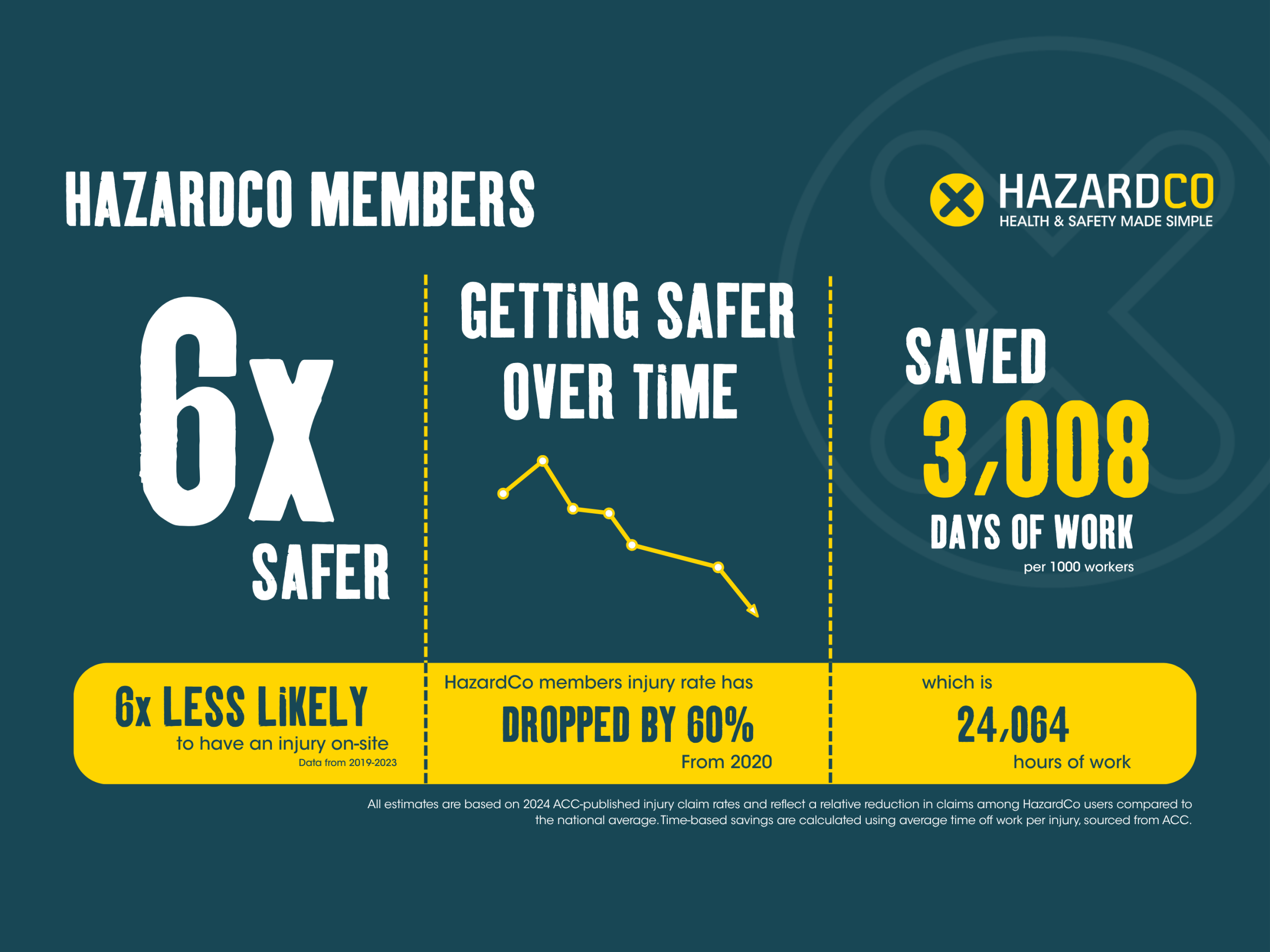
HazardCo members are 6.5 times less likely to have an injury
The latest industry data proves our members are safer on-site. When you look at the national average, the number of injuries on site is staggeringly high (111 injuries per 1000 workers), but HazardCo crews are bucking the trend with only 17 injuries per 1000 workers. Showing that our members see a massive reduction in accidents compared to the rest of the country, this also means fewer broken bones, fewer work stoppages, and more teams staying on the tools. It’s simple: our system works because it makes safety part of the job, not a mountain of paperwork.
The cost of Injuries: What does that mean in the real world?
When injuries occur on site, the impact adds up quickly. On average, each injury leads to 32 days off work. Across the country, this equates to 3,552 lost workdays per 1,000 workers. In comparison, HazardCo members avoid around 3,008 of those lost days per 1,000 workers. This clearly demonstrates how strong safety practices help prevent injuries and keep people on site.
The business impact
Keeping your team safe isn’t just about doing the right thing; it’s smart business. Every time someone gets hurt on site, the costs start piling up, from lost wages and replacement labor to the massive headache of project delays. Because HazardCo sites have so many fewer accidents than the national average, our members aren’t just protecting their people; they’re saving money. By cutting out those preventable injuries, you keep your jobs moving, your costs down, and your business running exactly the way it should.
Beyond the bottom line, a safe site is a badge of honor. It tells your clients you’re a professional outfit they can trust with their biggest projects, and it tells your team you actually care about their well-being. In an industry where good people are hard to find, being known as the safest crew in town makes you the employer of choice.
The HazardCo Advantage
At HazardCo, we believe everyone deserves to go home safely at the end of every shift. The latest industry data proves our members are doing exactly that, with far fewer injuries than the national average. But staying safe isn’t just about avoiding accidents; it’s about running a smarter, more professional business. Our digital tools guide teams through the right safety steps on site, from Site Reviews and risk assessments to toolbox talks, site inductions, and incident reporting, all in the HazardCo App.
Our mission is simple: keep the person at the top of the ladder safe, and the data shows it’s working.
*HazardCo incident data reflects reported events meeting ACC injury claim criteria and does not represent confirmed ACC-accepted claims. National benchmarks are based on published ACC work-related injury claim rates (2024) and are used for indicative comparison purposes only. Wage loss estimates are illustrative only, based on an average of 32 days off work at approximately $250/day, and reflect wage-related costs only. Individual outcomes will vary.
If you’re a main contractor in residential building, the way you handle health and safety is about to get a whole lot more attention. And it’s not just about what your own team is doing, it’s about everyone else on-site, too.
What’s changing?
WorkSafe is currently working on a new Approved Code of Practice (ACOP) specifically for residential construction. The big focus of this new code is overlapping duties. That’s a fancy way of saying: when you’ve got multiple different businesses (PCBUs) working on the same site at the same time, who is responsible for what?
Public consultation is set for 20 April to 10 May 2026, and once approved, to be in effect by July 2026. By following this ACOP means you’re considered to be compliant.
What does this look like on-site?
When your subbies are on-site, you share the responsibility alongside your subbies for their safety. The new rules will guide you on how to talk to each other, how you coordinate the risky stuff, and how you keep a record of it all.
Right now, a lot of sites handle this with a quick “be safe, mate” on day one, or a paper form that ends up shoved under the truck seat. That’s the gap WorkSafe is looking to close.
How Project Plus does the heavy lifting
We know you’ve already got enough on your plate without becoming a full-time H&S auditor. That’s where HazardCo’s Project Plus comes in.
It gives your contractors direct access to the HazardCo system, so they’re on the same page as you from the start. No more chasing paperwork.
With Project Plus, you get:
- Clear expectations: Your site requirements are right there in their pocket before they even hop out of the ute.
- One slick system: Everyone is using the same tools, making coordination heaps easier.
- Digital paper trail: You’ve got a solid record of H&S activity that you can actually find when you need it.
- A better culture: Safety becomes part of how the whole crew works, not just an extra task for your employees.
Once the ACOP process has been completed, WorkSafe will be checking to see if you’ve kept up with the changes. From what we can see, they’re looking for evidence of consultation, cooperation & coordination across your team and sites. Getting your systems sorted now is the smart way to run a professional site.
Keen to see how Project Plus can sort your subbies? Chat with our HazardCo advisors or check it out in your Hub today.
Roadside drug testing has now been rolled out across New Zealand following successful trials in Wellington. While the focus is on improving road safety, the change could also have practical implications for businesses that rely on staff driving for work.
Here’s what employers need to know.
What do the roadside tests check for?
There has been some confusion in the media about prescription medications triggering roadside drug tests and leaving drivers stranded. To clarify the facts, we’ve spoken with NZ Police, pharmacists, and experts involved in the supply and use of the saliva testing devices.
The roadside saliva tests are designed to detect specific drugs at specific threshold levels. Many common prescription medications, including ADHD medications, will not trigger a positive roadside result, either because they are not included in the test panel or because the detectable thresholds are set well above normal therapeutic levels.
What about medicinal cannabis?
Medicinal cannabis containing THC can trigger a roadside drug test, even if it has been legally prescribed by a doctor.
The test does not distinguish between medicinal and recreational cannabis — it simply detects the presence of THC.
If you have employees who drive for work and use prescribed medicinal cannabis, it’s important they understand this risk. A confidential conversation can help ensure everyone understands the potential implications for driving and workplace safety.
How the testing process works
The process is similar to alcohol testing and involves two stages.
- Initial roadside screening test – This indicates whether target drugs may be present.
- Confirmatory test – If the first test is positive, a second test is conducted to confirm the result.
While false positives are considered very unlikely, they are not impossible.
What this means for your business
If one of your drivers returns a positive roadside test, they will be stood down immediately and unable to continue driving — even if they believe the result is incorrect or related to prescribed medication.
In this situation:
- The vehicle will remain where it is.
- The driver cannot continue the trip.
- Another authorised driver will need to attend and recover the vehicle.
This is not a new challenge for some industries. Trucking companies, for example, have long planned for situations where drivers cannot continue due to alcohol testing or medical events. However, many businesses that rely on staff driving may not yet have considered how they would manage this scenario.
Potential consequences for businesses include: stranded vehicles, operational disruption, stand-down costs, and possible insurance implications.
What should businesses do now?
The best first step is simply to talk about it with your team. Consider asking a simple question:
If a driver was stood down at the roadside, what would we do next?
Some practical things to think through include:
- Who could step in to take over driving if needed?
- How would they be contacted?
- Does everyone know the process if something happens?
- Do staff have the ability to contact you quickly if they are stopped?
- Are any workers on prescribed medications that could affect their driving?
It may also be helpful to write down a basic plan. Even a simple process shows that the situation has been considered and discussed with your team.
Need to talk it through?
If you’d like to discuss how roadside drug testing might affect your business, feel free to give us a call.
The NZ Police have detailed information here: https://www.police.govt.nz/advice-services/drugs-and-alcohol/updates-drug-driving-legislation
If you want to see the actual drug limits in the legislation, they’re here: https://www.legislation.govt.nz/act/public/2022/0005/latest/LMS378964.html
Roadside drug testing has now been rolled out across New Zealand following successful trials in Wellington. While the focus is on improving road safety, the change could also have impacts for businesses where workers drive between sites, move vehicles, or travel to and from blocks and orchards on public roads.
Here’s what employers need to know.
What do the roadside tests check for?
There has been some confusion in the media about prescription medications triggering roadside drug tests and leaving drivers stranded. To clarify the facts, we’ve spoken with NZ Police, pharmacists, and experts involved in the supply and use of the saliva testing devices.
The roadside saliva tests are designed to detect specific drugs at set threshold levels. Many common prescription medications, including ADHD medications, will not trigger a positive roadside result, either because they are not included in the test panel or because the detectable thresholds are set well above normal prescription levels.
What about medicinal cannabis?
Medicinal cannabis containing THC can trigger a roadside drug test, even if it has been legally prescribed by a doctor.
The test does not distinguish between medicinal and recreational cannabis; it simply detects the presence of THC.
This is particularly relevant for businesses where workers are regularly driving utes, trucks, or other vehicles between sites or on public roads. If you have workers who use prescribed medicinal cannabis, both you and they must understand the risk of being stuck. A confidential conversation can help everyone understand the potential impacts for driving, vehicle/stock movements and workplace safety.
How the testing process works
The process is similar to alcohol testing and involves two stages.
Initial roadside screening test: This indicates whether target drugs may be present.
Confirmatory test: If the first test is positive, a second test is conducted to confirm the result.
While false positives are considered very unlikely, they are not impossible.
What this means for your business
If one of your drivers returns a positive roadside test, they will be stood down immediately and unable to continue driving, even if they believe the result is incorrect or related to prescribed medication.
This could mean a worker is left roadside in a rural area, and the vehicle or load cannot be moved until another authorised driver arrives. During busy or time-sensitive periods like harvest or stock transfers, even a short delay can have a knock-on effect across the operation.
This is not a new challenge for some industries. However, many businesses rely on small teams, seasonal workers, or contractors, and may not yet have considered how they would manage this situation.
Potential consequences include operational disruption, delays to time-critical work, and additional costs if vehicles or staff need to be recovered at short notice.
What should businesses do now?
The best first step is simply to talk about it with your team. Consider asking a simple question:
If a driver was stood down at the roadside, what would we do next?
Some practical things to think through include who could step in to take over driving, how they would be contacted (especially in areas with limited coverage), and whether workers know what to do if they are stopped while travelling between sites. It’s also worth considering whether any staff are on prescribed medications that could affect their ability to drive, and talking it through to make sure it is managed appropriately and confidentially.
It may also be helpful to write down a basic plan. Even a simple process shows that the situation has been considered and discussed with your team.
Need to talk it through?
If you’d like to discuss how roadside drug testing might affect your business, feel free to give us a call.
The NZ Police have detailed information here: https://www.police.govt.nz/advice-services/drugs-and-alcohol/updates-drug-driving-legislation
Looking for something in particular?
HazardCo members are safer than ever, and the latest stats prove it
At HazardCo, we’re all about making health and safety simple – and it’s working.
New data shows that HazardCo members i...
If you’re a main contractor in residential building, the way you handle health and safety is about to get a whole lot more attention. And it’s not just about what your own team is doing, it’s ...

Roadside drug testing has now been rolled out across New Zealand following successful trials in Wellington. While the focus is on improving road safety, the change could also have practical im...
Roadside drug testing has now been rolled out across New Zealand following successful trials in Wellington. While the focus is on improving road safety, the change could also have impacts for ...